The Best ASMR Microphone for Relaxation & Sleep (Without a Studio Setup)
Many ASMR listeners disengage quickly due to uncomfortable audio texture rather than trigger choice.
ASMR microphone
relaxation
sleep
Updated: Feb 26, 2026 · 8 minutes read
Modular Video Kits for Growing Business.
Did you know that most ASMR listeners click away within the first 30 seconds of a video?
It is rarely because your "triggers" are wrong. It is because the audio texture is uncomfortable. Many creators rely on luck, hoping their bedroom is quiet enough or that editing software can fix a harsh hiss. But true, sleep-inducing ASMR isn't just about volume—it is about cleanliness and texture.
If your microphone picks up the hum of a laptop fan or makes a soft whisper sound like scraping sandpaper, the listener's brain stays alert instead of drifting off. To move from "it sounds okay" to "I can't stop listening," you need a tool designed for intimacy.
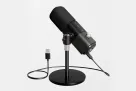
That’s where the AM25X changes the game.
1. Deconstructing the "Tingle": What Does Relaxing Sound Look Like?
Before we talk about hardware, let's reverse-engineer a "Master-Class" ASMR track. What actually makes a sound hypnotic?
A sound that puts people to sleep usually consists of three distinct structural layers. If your microphone misses one, the magic breaks.
Layer 1: The Primary Trigger (Texture & Body)
Whether it is a whisper, a finger flutter, or a brush on a mic cover, the sound must have "fleshiness." It should sound full and rounded, not thin or brittle.
Layer 2: The Room Ambience (The "Air")
This is not noise; it is the "fuzz" around the sound. It helps the listener perceive the boundaries of the space, creating a subconscious sense of safety and presence. A microphone that cuts this out completely makes the audio feel sterile and unnatural.
Layer 3: The Low-Frequency Foundation (Safety)
Warm low frequencies simulate the feeling of a heartbeat or the safety of the womb. This is the cornerstone of eliminating anxiety.
The AM25X Advantage: Standard office microphones try to "flatten" audio for clarity. The AM25X is designed to peel the sound like an onion. It retains the delicate balance of these three layers, allowing the listener to feel the "breath" of the audio, creating a 3D sensation even in a mono or stereo setup.
2. Why Your Current Mic Is Causing "Auditory Anxiety"
Most microphones are engineered to make you sound loud in a Zoom meeting. In the world of ASMR, these design choices are often disastrous.
When a microphone over-sharpens high frequencies or lacks dynamic range, it triggers a listener's "fight or flight" response rather than their relaxation response. Here is a breakdown of common "fail moments" for creators:
Table 1: Common ASMR Failures vs. The AM25X Solution
The "Fail" Moment
The Listener's Reaction
How AM25X Solves It
Harsh Nail Tapping
The Frown: High frequencies become piercing spikes. Brain enters "Alert Mode."
High-Frequency Smoothing: The AM25X suppresses harsh transient spikes while keeping the sound crisp.
Explosive Breathing
The Wince: "Plosives" (puffs of air) hit the capsule. Listener wants to take off headphones.
High Tolerance Pickup: Excellent off-axis rejection allows for gentle, wind-free breathing sounds.
Ear Fatigue (10 Mins)
The Exhaustion: The sound is too compressed and aggressive. Listener stops watching.
Natural Dynamic Range: The sound fluctuates softly, mimicking the natural hearing of the human ear.
Midnight Hiss
The Break: Background static or computer hum becomes audible during quiet pauses. Immersion is lost.
Cardioid Silence: Extremely low self-noise ensures the mic only records the silence you create.
3. From "Recording" to "Sound Art": The AM25X + ST20 Combo
The soul of ASMR lies in movement. If you bolt your microphone to a desk stand, your audio will feel static and dead. You need to move around the sound.
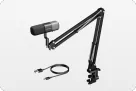
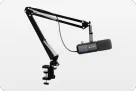
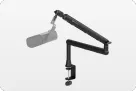
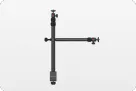
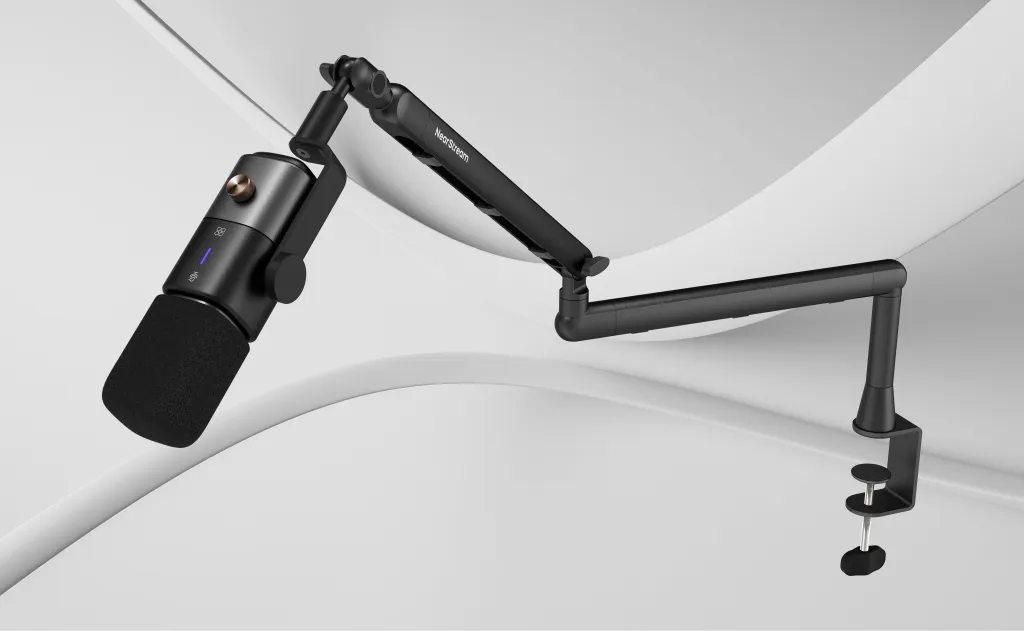
This is why pairing the AM25X with the ST20 Boom Arm is critical. It transforms the mic from a stationary object into a mobile ear. Here are three pro techniques:
The Vertical Hover (Books & Paper)
Setup: Extend the ST20 to its max height and point the AM25X straight down.
The Effect: This captures the full spectrum of page-turning sounds evenly. It records that highly sought-after "airy" paper rustle that feels like it’s happening right in front of the listener's face.
The 45-Degree Whisper (Intimacy)
Setup: Suspend the microphone to the side of your face, angled at 45 degrees toward your mouth.
The Effect: This is the "Golden Angle" for whispering. It avoids the "P" and "B" air bursts (plosives) hitting the capsule directly, allowing your voice to flow like liquid into the listener's ear without any harsh pops.
The Low-Altitude Glide (Tapping)
Setup: Lower the arm so the mic is inches from the desk surface.
The Effect: This captures the "thud" and vibration of objects being tapped on the table. It gives the sound "meat" and low-end thickness that feels incredibly grounding.
Pro Tip: The ST20 isn't just a holder; it's an insulator. When you adjust your posture or move your chair, the arm absorbs the micro-vibrations, preventing those deep "earthquake" rumbles from ruining a quiet take.
4. Will the AM25X Grow With You? (The Growth Path)
A common fear for new creators: "If I buy a USB mic now, will I have to throw it away when I become a pro?"
The AM25X is unique because it bridges the gap between consumer and professional gear. It is designed to be a long-term companion, not e-waste.
Stage 1: The Beginner (Simplicity)
Setup: USB-C directly to your laptop or phone. Workflow: No sound card, no mixer. Just plug it in. Result: You immediately produce audio that beats 90% of smartphone recordings. You can focus entirely on your performance, not the tech.
Stage 2: The Advanced (Refinement)
Setup: USB connection + OBS/Audacity filters. Workflow: You start experimenting with EQ and compression. Result: Because the AM25X provides a clean, neutral raw signal, it takes post-processing beautifully. You can sculpt the sound without fighting against hardware hiss.
Stage 3: The Professional (Expansion)
Setup: XLR connection to an Audio Interface. Workflow: You upgrade to a professional preamp or want to run two AM25X mics for a stereo binaural setup. Result: The AM25X supports XLR output. You don't need to buy new mics; you just change the cable. It remains the trusted "ears" of your setup even as your backend equipment becomes studio-grade. Verdict: The AM25X won't become the bottleneck in your creative journey.
Conclusion: The Best Gear Is Invisible
The best ASMR microphone shouldn't have a "sound." It shouldn't show off. It shouldn't distract. Its only job is to faithfully and gently transport the tiny vibrations from your room to someone else's brain.
By providing "electric" sound quality via the AM25X and limitless creative angles via the ST20 arm, you stop selling "audio files" and start delivering a service. You are handing a ticket to sweet dreams to people who are struggling to find peace in a noisy world.
Frequently Asked Questions (FAQ)
Q: Is the AM25X suitable for 3D (Binaural) ASMR? A: While a single AM25X is a mono Cardioid microphone, many creators use two AM25X units connected via XLR to an interface to create a classic "XY" or "Spaced Pair" stereo array. This creates a stunningly realistic 3D spatial experience where you can whisper from one ear to the other. Q: Do I need to buy a separate Pop Filter? A: The AM25X has a built-in high-density foam filter that handles light air bursts well. However, for ultra-close ASMR whispering, we recommend using the 45-Degree Side Address technique with the ST20 arm. This positioning is often more effective at stopping plosives than any external foam cover. Q: Can I connect the AM25X directly to my iPhone or Android for recording? A: Yes. The AM25X is USB-C compatible. With the correct adapter (Lightning or USB-C), you can record high-quality ASMR videos directly to your phone's camera roll, making it perfect for TikTok or Instagram Reels creators.






































 sales@nearstream.us