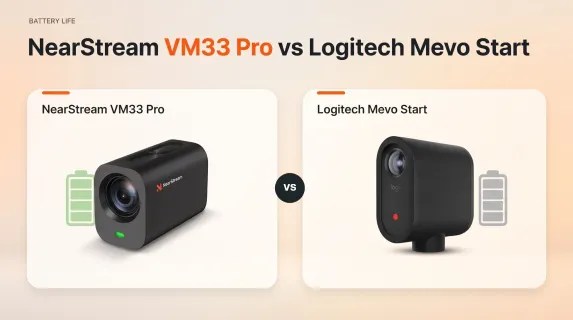
NearStream VM33 Pro vs Mevo Start: Battery Life Is More Than a Runtime Number
Compare Mevo Start and NearStream VM33 Pro beyond battery life alone.
battery powered streaming camera
camera for live streaming church
church livestream camera
Updated: Nov 15, 2026 · 8 minutes read
Modular Video Kits for Growing Business.
A longer battery rating doesn't always mean a more reliable streaming setup. Based on real Amazon customer feedback, this comparison examines battery aging, standby drain, charging time, and external power options. Learn how VM33 Pro's approximately 1.5-hour fast charging, built-in wired connections, and flexible production features help teams prepare for their next live event with greater confidence.
The battery question begins before the camera turns on
It is Sunday morning. The camera was packed away after last week’s service, and the volunteer expects it to be ready. Thirty minutes before going live, the battery indicator tells a different story.
Most comparisons ask only, “How many hours will it run?” Logitech rates Mevo Start at 6+ hours, while NearStream rates VM33 Pro at up to 4 hours. On paper, Mevo Start wins runtime. But Amazon reviews surface a second operational variable: how quickly and predictably the camera returns to a ready state.
For a battery powered streaming camera, usable runtime, standby behavior, charge time, battery age, and access to external power form one system. A longer maximum rating does not help if the device was stored partly discharged; a fast charge does not replace a power plan for an all-day tournament.
Battery and readiness comparison
Event-day consideration
NearStream VM33 Pro
Logitech Mevo Start
Practical implication
Manufacturer-rated runtime
Up to 4 hours
6+ hours
Mevo Start has the stronger headline runtime.
Charging
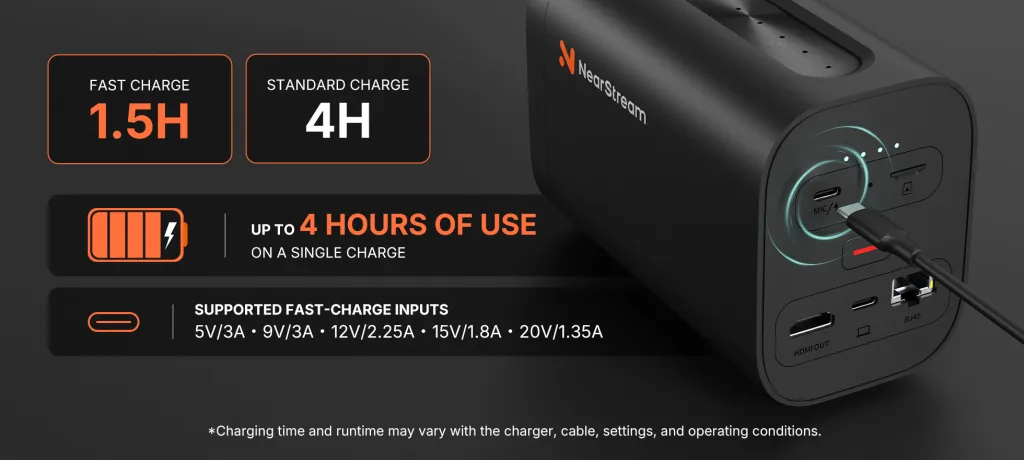
Approximately 1.5-hour fast charging; supports fast-charge protocol
USB-C charging; official page emphasizes extended battery life
VM33 Pro can shorten the recovery window when compatible power is used.
Control during setup
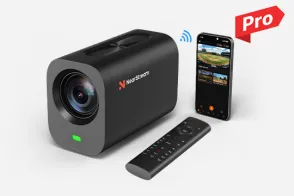
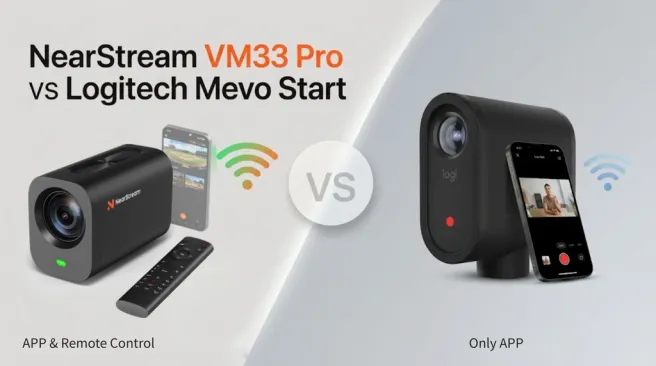
App plus included RF remote
App-centered controls
VM33 Pro can start/stop recording and handle common adjustments without keeping the phone as the sole controller.
Wired fallback
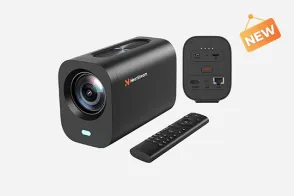
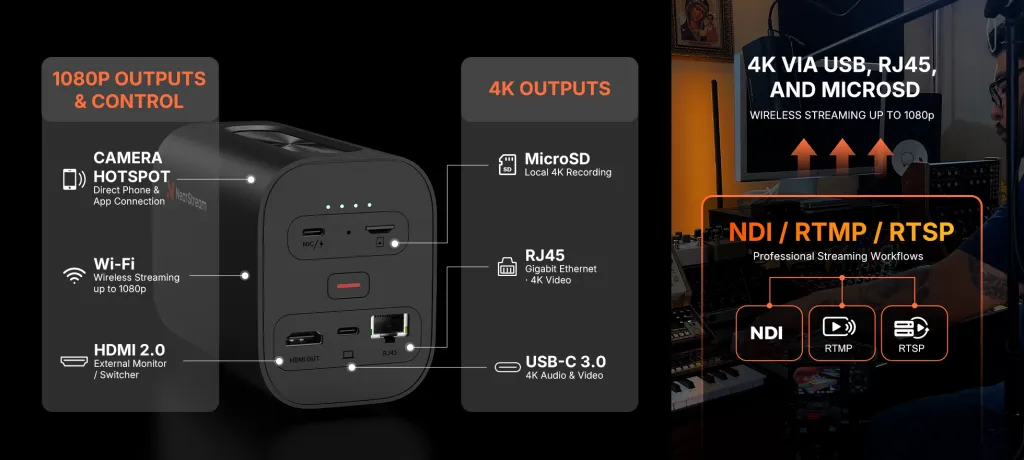
Built-in RJ45, USB-C, HDMI
Optional Ethernet power adapter; USB-C
A fixed venue may favor continuous power and wired routing over battery-only operation.
Local recording
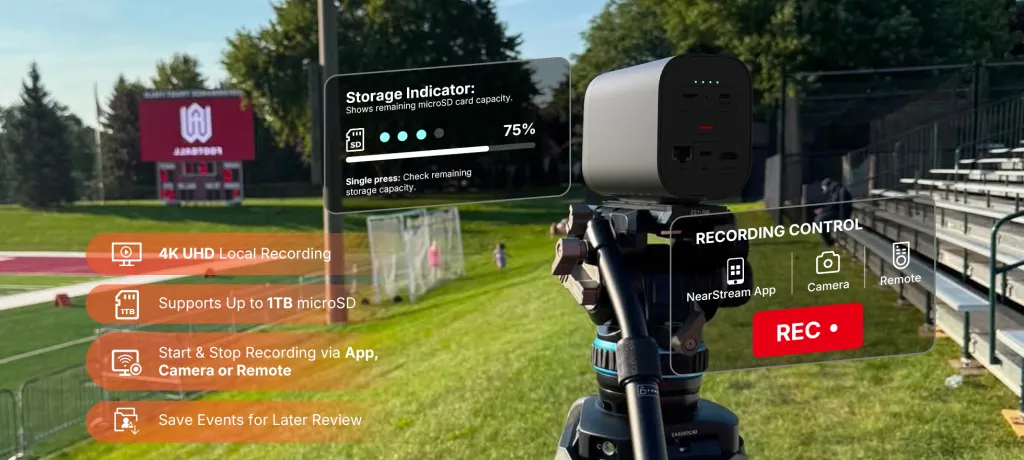
Up to 4K30 microSD
Up to 1080p30 microSD
Local recording can protect the deliverable, but it must be deliberately started and verified.
Rated runtime and an aging battery are different questions
Richard Smith initially reported successful church use, then updated the review after the battery changed:
We stream once a week with it on Wednesday for 1 1/2 hours and it almost dies before getting done, with a full charge. It now takes it a day or more to get a full charge.
— Richard Smith, 1-star Amazon review, September 9, 2020, later updated
This is one unit and one owner’s experience. It should not be interpreted as the expected life of every Mevo Start. It does show why a production team should test its own battery under current settings instead of relying forever on the original manufacturer rating.
The relevant metric is not only “hours when new.” It is “verified minutes today, with this battery, this network mode, this recording configuration, and this ambient temperature.”
Storage drain can turn packing into preparation debt
Hong described a side-by-side storage test after noticing battery loss while the camera was off:
After about a month, the comparison unit was at 95%; this unit was at 35%.
— Hong, 1-star Amazon review, October 19, 2026
The reviewer reported that support considered the behavior expected for that unit. This remains a customer account, not an independently verified battery specification. Its value for VOC research is the underlying job-to-be-done: users expect a camera stored after one event to be predictably available for the next.
The operational response is simple: never make storage state an assumption. Put a recurring battery check on the production checklist, especially after long gaps.
Marketplace condition can confuse product performance
Brianne E Reed-Pahang wrote about a unit sold as “like new”:
Won’t hold a charge past 75%.
— Brianne E Reed-Pahang, 1-star Amazon review, March 20, 2025
Because the review concerns a “like new” purchase, it should not be treated as evidence about every factory-new Mevo Start. It does highlight a buying risk: battery health and product condition are inseparable when purchasing used, open-box, or refurbished hardware.
How VM33 Pro addresses the readiness problem
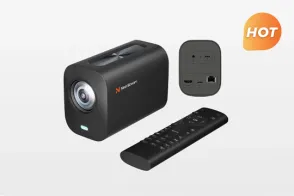
VM33 Pro does not beat Mevo Start’s rated runtime; NearStream lists up to 4 hours versus Logitech’s 6+ hours. Its counterpoint is approximately 1.5-hour fast charging. That makes VM33 Pro particularly relevant for teams with a defined setup window between sessions.
It also offers a different venue strategy. At a church, meeting room, or fixed event position, built-in RJ45 and USB-C provide options for designing around stable power and wired production rather than treating the internal battery as the only plan. HDMI can feed a compatible monitor or switcher, while microSD can hold a local recording.
The key is to avoid turning “fast charge” into another unchecked promise. Use a compatible charger and cable, confirm the camera’s actual behavior, and rehearse the complete power configuration.
A five-step readiness plan for either camera
Test present-day runtime. Run the intended stream and recording settings for longer than the planned event, not just until the camera turns on.
Check 24 hours before the event. This leaves time to charge, replace a cable, or move to continuous power.
Check again at setup. Long storage, battery age, temperature, and background behavior can change the starting percentage.
Define the power path. Decide whether the internal battery, a compatible external power source, or fixed venue power is primary.
Verify recording separately. A full battery does not prove that local recording is active or that storage capacity is sufficient.
For a church livestream camera, assign these checks to a named volunteer. “Someone probably charged it” is not a production process.
Scenario planning: runtime or recovery?
A six-hour tournament
Mevo Start’s longer manufacturer rating is the better starting point. Still test the actual unit and plan external power for delays, cold or heat, and multiple games. VM33 Pro may require continuous or supplemental power, but it provides optical zoom and higher-resolution wired/local options when those production needs outweigh pure runtime.
A weekly worship service
If the active production is under four hours and a charging routine exists, VM33 Pro’s fast-charge design can fit well. Its optical zoom, remote, HDMI, and built-in Ethernet may also matter more than the extra rated battery hours in a fixed sanctuary.
Multiple sessions in one day
The useful comparison is total availability: runtime plus the turnaround between sessions. VM33 Pro’s approximately 1.5-hour charging specification can reduce recovery time; Mevo Start’s longer rated run may reduce how often recovery is needed. Test both assumptions in the actual workflow.
Verdict: buy a power workflow, not a battery number
Mevo Start is the stronger choice when maximum manufacturer-rated untethered runtime is the priority. VM33 Pro is the stronger fit when fast turnaround, optical reach, built-in wired connections, physical remote control, and 4K local/wired production matter together.
The VOC lesson is not that one battery rating is false. It is that a wireless streaming camera becomes dependable only when the team measures current runtime, checks charge before the event, and has a fallback power route.
FAQ
Which camera has longer rated battery life?
Logitech rates Mevo Start at 6+ hours. NearStream rates VM33 Pro at up to 4 hours.
How long does VM33 Pro take to charge?
NearStream lists approximately 1.5 hours with its supported fast-charging workflow. Actual time depends on charger, cable, battery state, temperature, and use during charging.
Do Amazon battery reviews prove every Mevo Start will degrade?
No. They document individual experiences. They are useful for identifying readiness risks and test cases, not for estimating a universal failure rate.
Which camera is better for church livestreaming?
Mevo Start can be attractive when untethered runtime and a simple 1080p app workflow dominate. VM33 Pro is better suited when the church needs optical zoom, a remote, built-in Ethernet/HDMI, fast recharge, or 4K local recording.
Can either camera run from external power?
Both use USB-C-related power workflows; Logitech also sells an optional Ethernet power adapter for Mevo Start. Confirm the exact supported charger and continuous-use configuration with the manufacturer before a critical event.



























 sales@nearstream.us